
Flu Vaccination
Flu Season Has a Real Cost for Small Businesses
Winter illness continues to place real pressure on New Zealand businesses, particularly small and mid-sized organisations where even a few absences can disrupt operations.
Flu is often treated as an inconvenience; however, the data shows it’s much more than that.

Insights from the 2025 Umbrella Wellbeing Report
$1,319
the costs of absences in 2024 per employee
6 days
estimated productivity day loss per employee per month
$46.6B
estimated annual total cost for employers nationwide
Setting the Context: Flu Is a Workforce Risk, Not Just a Seasonal Admin Task
In 2024, New Zealand workers averaged 6.7 sick days per employee, the highest level ever recorded. That figure has risen from 5.5 days in 2022. Almost 13 million working days were lost nationally, at a total cost of $4.17 billion to employers, or around $1,319 per employee.
These findings are outlined in the Southern Cross Workplace Wellness Report 2025 and reported by RNZ, HRD New Zealand, and the Umbrella Wellbeing Report 2025.
Non-work-related illness has remained the leading cause of staff absence in New Zealand for at least 13 years, and nine in ten employers encourage staff to stay home when they are unwell. For a small team, that impact is immediate. Two or three people away at the same time can affect customer service, output, revenue, and morale.
Flu vaccination is not simply a seasonal benefit, it is a practical step that helps protect both your people and your business.
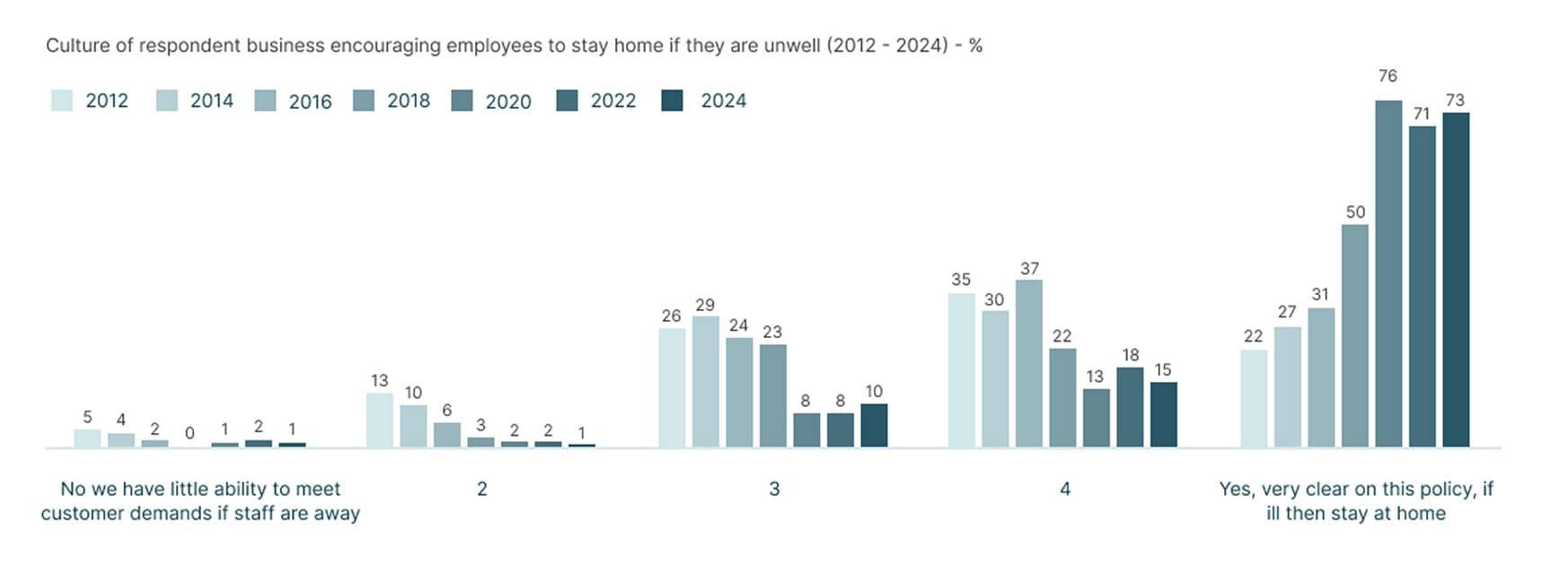
Source: Workplace Wellness Report 2025
Image source: southerncross.co.nz

How Flu Increases Heart Attack and Stroke Risk
Influenza is often understood as a respiratory virus, yet its impact can extend well beyond the lungs.
Cardiovascular strain increases during acute infection, particularly in individuals with underlying heart conditions or risk factors. The Public Health Communication Centre explains that influenza infection can increase the risk of heart attack and stroke by up to sixfold in the days following infection.
For people with existing cardiovascular disease, that risk is even higher. In simple terms, flu places stress on the body. Inflammation increases, blood is more likely to clot, and the heart works harder.
For someone with an existing heart condition, that combination can trigger a serious event. Research also shows that flu vaccination reduces major cardiovascular events by around one third in higher-risk individuals. Heart disease and stroke remain leading causes of death in New Zealand, which means reducing influenza exposure may do more than lower sick leave across a workplace.
It may also help reduce the likelihood of sudden medical emergencies during peak winter illness periods. Within this context, flu vaccination can be viewed as part of a broader workplace health and wellbeing strategy rather than only a seasonal initiative.
6X
Influenza infection can increase the risk of heart attack and stroke by up to six-fold in the days following infection.
1 in 3
Flu vaccination can reduce major cardiovascular events by around one third in higher-risk individuals.
FLU VACCINATIONS

Simple Steps to Protect Your Team Before Winter
Flu season is here, and protecting your team
does not need to be complicated.
Some businesses choose an on-site clinic so staff can be vaccinated in one visit. Others prefer flu vaccination vouchers, which allow employees to book at a time and location that suits them. Clear communication before winter, along with identifying team members who may be at higher cardiovascular risk, can also help improve uptake. LifeCare manages logistics, bookings, and delivery, making the process efficient even for smaller teams. Early action can help prevent larger disruptions later in the season.
At LifeCare, we have designed our flu voucher system to be flexible, simple, and aligned with how your business operates. Some organisations prefer to manage the process centrally, while others want a hands-off option that reduces administration. Flu vouchers can be redeemed at more than 400 pharmacies and medical centres across New Zealand, making access straightforward for teams nationwide.
Opt 1: Order Through Our Customer Portal
This option suits businesses that prefer to manage orders centrally.
Simply:
- Log in to the LifeCare Customer Portal using your email and password
- Select the number of flu vouchers required
- Pay securely by credit card or provide a purchase order number to charge to your account
- Once your order is complete, vouchers are emailed directly to you, or to individual employees if their email addresses are included at the time of ordering. If vouchers are sent to you centrally, they can be distributed digitally or printed if required.
This approach keeps everything in one place and provides clear oversight of uptake across your organisation.
Opt 2: A Customised Ordering Link
If you are looking to reduce internal administration, we can set up a customised flu voucher form for your organisation.
The process is simple:
- Contact your Account Manager or complete the online enquiry form and we will contact you directly
- We create a tailored form specific to your organisation
- You distribute the link directly to your employees
- Employees complete the form and order their vouchers
- Vouchers are sent directly to them via email
- The form can include a drop-down list of your sites or locations, making it easy to manage orders across multiple teams.
Your organisation is invoiced monthly based on vouchers ordered, using an agreed purchase order number. If you are unsure which approach best suits your organisation, speak with your Account Manager or complete the online form and we will reach out to you directly.
From Flu Prevention to First Aid Response
Vaccination lowers risk, although it does not remove it entirely. Under the Health and Safety at Work Act and the Health and Safety at Work Regulations, employers must provide adequate first aid facilities, equipment, and access to trained first aiders. WorkSafe’s detailed guidance is outlined in First aid at work.
Prepared workplaces ensure that:
- First aid kits are appropriate to the nature of the work
- Trained first aiders are available during operating hours
- Emergency procedures are clearly communicated
- Automated external defibrillators are accessible where risk warrants
- Vaccination helps reduce the likelihood of illness and serious complications during flu season, while practical first aid capability ensures that if an emergency does occur, teams can respond quickly and effectively. Prevention and preparedness work together as part of responsible health and safety leadership.
In a cardiac emergency, response time is critical. Clinical guidance shows that for every minute defibrillation is delayed; survival decreases by around 7 to 10 percent. Teams who are trained, confident, and familiar with their equipment are more likely to respond without hesitation, which can make a life-saving difference. Guidance on the role of automated external defibrillators in basic life support is available through the Australian and New Zealand Committee on Resuscitation on the ANZCOR website.
LifeCare supports workplaces with hands-on, workplace-based training through our Basic Life Support course and dedicated Heart Start Training course. Staff learn CPR skills, practise using an AED, and build emergency response processes that reflect their real work environment.
Real Workplace Confidence – Pact Packaging
At Pact Packaging Henderson, emergency preparedness moved beyond theory and into practical workplace capability. Working alongside LifeCare, the team completed practical First Aid Drills designed around the genuine risks of a manufacturing environment, including stroke, heart attack, and severe bleeding. These sessions reflected the pace and pressure of an operational factory floor, helping the training feel realistic and relevant to everyday work conditions.
Participants practised CPR, operated an AED, and worked through clearly defined response roles during simulated cardiac events. For many, it was the first time applying defibrillator skills in conditions that closely mirrored their workplace environment.
As confidence increased, communication became clearer and more coordinated, and the hesitation that can occur during high-pressure moments began to reduce. The team left not only with refreshed knowledge but with a shared understanding of how they would respond together if an emergency occurred.
That level of readiness does not happen by chance. It is built deliberately through realistic training, repetition, and leadership that prioritises the safety and wellbeing of its people.
“We’re incredibly proud of our first aiders for their engagement and commitment, and a big thank you to Life Care for delivering a practical, impactful session. The energy, teamwork, and learning captured on the day are a strong example of Pact’s commitment to keeping our people safe.”
Pact Packaging – Henderson
What the Health and Safety at Work Reform Bill Means for Small Businesses
The Health and Safety at Work Reform Bill was introduced on 9 February 2025 and has passed its first reading. The Bill proposes refinements to the way critical risks are prioritised within organisations. A practical summary of the proposed changes is provided in Business Canterbury’s article on the Health and Safety at Work Amendment Bill.
Ongoing Responsibilities for Small Businesses
A small PCBU is defined as a business with fewer than 20 workers for at least nine out of twelve months, accounting for seasonal fluctuations. Small businesses must still manage critical risks under Sections 36 to 43 of the Health and Safety at Work Act, including providing appropriate training, supervision, information, personal protective equipment, and adequate welfare facilities such as first aid.
The reform places greater emphasis on identifying risks that could result in serious harm and ensuring proportionate controls are in place. For small PCBUs, the scope of duty becomes more clearly aligned with managing high-consequence risks rather than focusing heavily on administrative processes.
Managing Foreseeable High Consequence Risks
WorkSafe’s Introduction to the Health and Safety at Work Act 2015 continues to outline the responsibility of PCBUs to manage health and safety risks so far as is reasonably practicable.
Within this context, a structured flu vaccination programme can form part of a broader workplace health and wellbeing approach during peak winter illness periods. Reducing the impact of influenza across the workforce may help lower the likelihood of sudden, high-impact health events and operational disruption.

Taking a Practical Step Before Flu Season Peaks
Health and safety leadership is not only about responding to incidents after they occur. It also involves recognising foreseeable risks and taking practical, proportionate steps in advance.
Through our Flu Vaccination programmes, we help reduce preventable illness and short-term cardiac strain during peak season. Through Health Monitoring, we support early identification of underlying risk factors that may otherwise go unnoticed. Through structured training such as Basic Life Support and Heart Start Training, we help ensure teams are prepared to respond confidently if an emergency occurs.
When these elements work together, prevention and preparedness become part of operational strength rather than simply a seasonal response.
If you would like to organise flu vaccination vouchers, arrange an on-site clinic, discuss health monitoring, or book emergency response training, speak with your Account Manager, email us at info@lifecare.co.nz or contact us here.