27/11/2018
How to avoid arriving like a zombie!
SEEING CHRISTMAS DECORATIONS UP IN THE SHOPS, I THOUGHT I’D TAKE THE LIBERTY OF TALKING ABOUT LOOKING AFTER OURSELVES DURING…

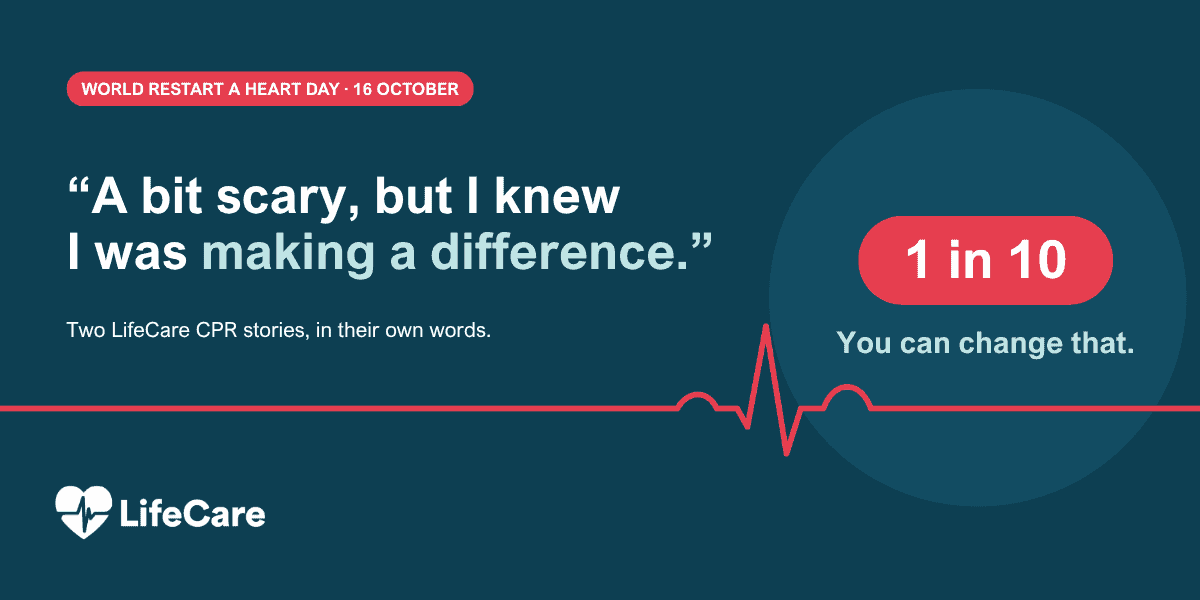
Brad Smith, John Stadelman and Mo Dorrazaei have all faced that moment for real. All three work at LifeCare, helping keep New Zealand workplaces healthy and safe. All three have knelt beside someone whose heart had stopped, and started pushing.
Today is World Restart a Heart Day. Only about one in ten people survive a cardiac arrest, and the people most likely to change that aren’t paramedics. They’re the ones who happen to be there. Here are Brad, John and Mo’s stories, in their own words.
Brad is our Quality and Training Manager. He’s also a GoodSAM responder, which means that when someone nearby goes into cardiac arrest, his phone can light up with an alert. And when it does, he goes.
“The CPR situations that I’ve been involved with have been in response to the alerts received from the GoodSAM app,” he says. “I’ve arrived on scene prior to emergency services and begun CPR immediately. Emergency services have then arrived, and in conjunction with them, we have continued with CPR and AED application.”
He doesn’t pretend it’s easy. “Whilst a bit scary performing CPR, the important thing for me was knowing that I was making a difference.”
That honesty matters. So many people hold back because they’re afraid of getting it wrong. Brad’s answer is the motto we live by at LifeCare: doing something is better than doing nothing.
“Early CPR and early AED application does make a difference,” he says. “This could be you. This is your chance to save a life.”
John is an Occupational Health Technician in our Christchurch team. Before LifeCare, he worked as an Emergency Medical Technician and ambulance paramedic. But the night he’s sharing wasn’t a shift. It was a night off.
“It was a Tuesday night, going out for a movie and drinks with friends. We were leaving the theatre when I noticed two men kneeling on the ground with a small crowd around them.”
The two men were trying to get a response from a man lying on his back. John introduced himself and checked: no breathing, no pulse. In the noise and the crowd, he did what his ambulance training had taught him. He gave everyone a job. One man ran for the theatre’s AED. The other stayed on the phone to emergency services.
“I started giving chest compressions and got my barrier device for providing breaths from my keychain. After two rounds of CPR, the AED arrived, and I assisted in placing the pads on the man’s chest. We gave one shock, and I continued providing compressions.”
Then, after another round of CPR, the moment every responder hopes for: the man started coughing. Emergency services arrived moments later and took over.
“I feel I made a difference in that emergency,” John says, “and that still brings me joy to this day.“
His advice for anyone who’s never done CPR is wonderfully human. “It is always a hectic environment, and the best thing you can provide, besides good first aid skills, is a calm voice for others.”
Mo is an Occupational Health Technician and first aid trainer in our Auckland team, and a paramedic by profession. He has cared for more than 200 cardiac patients. But the story he wants to share isn’t from work. “Today I want to share a story where I performed CPR,” he says, “not as a paramedic, but as a bystander.”
It was a year ago, and Mo was on holiday at the beach. “I heard people screaming for help. A kid was drowning and had been taken out of the water.”
Mo approached safely and checked for a response. The child was unconscious. He sent one person to call 111 and another to find an AED. Then he checked for breathing. There was none. “I knew he was in cardiac arrest, and that my effort would make a huge difference.”
He started compressions straight away. The child’s mother was there, and Mo talked her through giving rescue breaths. When someone arrived with an AED, Mo asked if he knew how to do CPR. He’d done it before, so Mo got him pushing on the chest too: hard and fast.
Together they kept going for more than 20 minutes. The AED delivered more than eight shocks. And then, finally, the child started breathing. They placed him in the recovery position and waited for paramedics to take him to hospital.
Later, Mo heard from colleagues who had transported the child: he survived, and after about three weeks he went home.
“You should always remember: push hard, push fast and shock as soon as possible,” Mo says. “I could save that person’s life. You could have done that too.”
Brad was scared. John’s scene was chaos. Neither of them waited to feel ready. And beside John that night were two strangers who stayed, fetched, called and helped. They mattered too.
In Aotearoa, bystanders are the ones who step in at 75% of cardiac arrests. Next time, that could be you.
If someone is unresponsive and not breathing normally:
And if you’ve been meaning to learn CPR, or your team’s training has lapsed, let today be the nudge. Find out where your nearest AED is.
Because one day, someone’s second chance might be in your hands. Together, we can save lives.
Statistics: NZ Resuscitation Council.