
workplace injury prevention
Are You Hiring for Safety and Capability?
When the risk is foreseeable and the tools to assess it are available, the response should be deliberate. Prevention starts before day one.
For large organisations, the cost of a preventable workplace injury or illness extends well beyond the immediate incident. It shows up in productivity loss, workforce disruption, ACC levies, and the time your H&S and HR teams spend managing consequences that could have been avoided.
From injury and illness response to prevention: what large organisations need to know about pre-employment assessments.

Understanding the Impact of Workplace Injuries
$5.4B
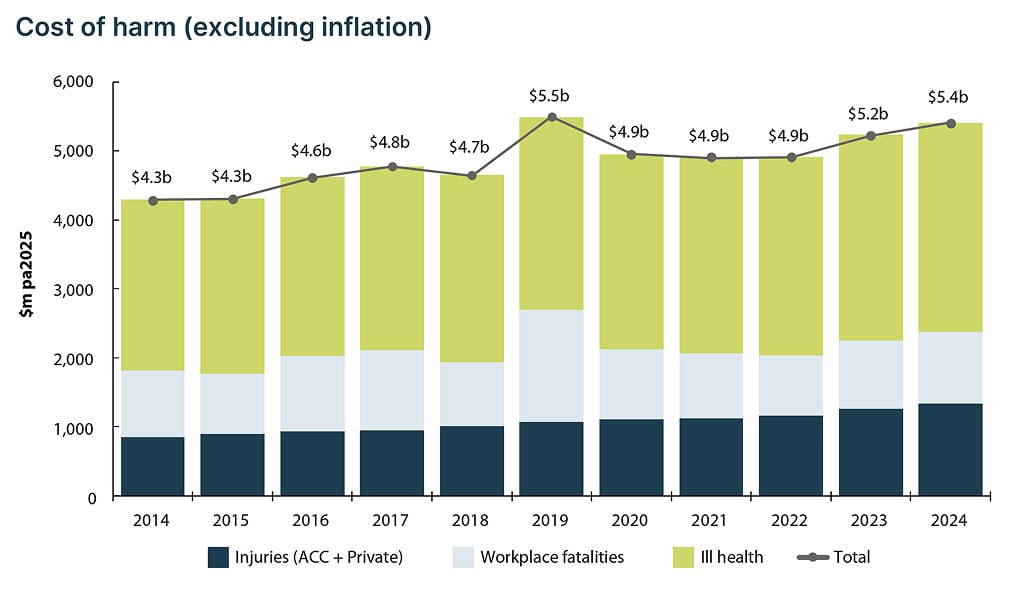
Total cost of workplace injuries, illnesses and fatalities in NZ in 2024
209,400
Work-related injury claims in New Zealand in 2024
$1.34B
Serious injury ACC costs and lost income to individuals in 2024
Source: Business Leaders’ Health and Safety Forum, State of a Thriving Nation 2025 | Stats NZ Injury Statistics: Work-Related Claims 2024
The Cost of Workplace Harm Is Rising.
Prevention Starts Before Day One.
In 2024, the total cost of workplace injuries, fatalities, and long-term illness in New Zealand reached $5.4 billion, up from $5.2 billion the year prior, according to the Business Leaders’ Health and Safety Forum’s State of a Thriving Nation report 2025. That figure includes ACC costs, lost income, and the estimated burden of work-related disease and long-term injury.
For large organisations managing workforces across multiple sites and industries, this is not an abstract number. It represents lost productivity, workforce disruption, increased ACC levies, strained HR and health and safety teams, and reputational exposure.
What the data increasingly shows is that some workplace risks may be identified before employment, where a worker’s current health or functional capability is not appropriately matched to the inherent requirements of the role. Pre-employment assessment is one part of a broader risk-management approach that must also include effective workplace controls, training, supervision and safe work design.
Prevention, in this context, does not begin on a worker’s first day. It begins in the recruitment process.
Figure 1: The harm of workplace injuries, illness and fatalities was $5.4b in 2024, and has trended higher over the last decade

Why Lost Time Injuries and Work-Related Illness Cost More Than You Think
A Lost Time Injury (LTI) is rarely just a single line item. When a worker is unable to perform their role due to a workplace injury or illness, the visible costs – ACC claims, medical appointments, temporary cover – are only part of the picture.
For large organisations, the broader impact includes:
- Disruption to operational continuity and project delivery
- Increased pressure on remaining team members, which can compound injury risk
- Time spent by H&S, HR, and management on case management and investigation
- Impact on workforce morale, contractor relationships, and how your organisation is perceived by clients and partners
- Reputational exposure with clients, contractors, and regulators
- Impact on Lost Time Injury Frequency Rate (LTIFR) metrics and board-level reporting
- Rising ACC levies where injury rates remain elevated
According to Stats NZ, 209,400 work-related injury claims were made in New Zealand in 2024. The most affected workers are those in physically demanding roles including labourers, technicians, trades workers, and community and personal service workers – the same workforce groups many large organisations rely on heavily.
Importantly, the cost of workplace harm extends beyond injuries. Work-related illness, also contributes significantly to the overall burden of workplace harm.
Pre-employment assessment may establish relevant baseline information or identify existing health factors, while ongoing exposure controls and health monitoring are required to identify and manage health risks arising from work.
7
A single Lost Time Injury can affect 7 key areas of your business: operations, workforce capacity, compliance, reputation, reporting, ACC levies, and project delivery.
2B
The Business Leaders’ Health and Safety Forum estimates at least $2 billion of the 2024 total relates to work-related disease and long-term illness.
The Hidden Cost of Getting Pre-Employment Decisions Wrong
A pre-employment medical assessment is not simply an administrative step. It is one of the most practical and defensible tools available to employers for managing workforce health risk before it becomes a workplace incident.
Risks of Inadequate Pre-Employment Health Assessment
When a worker is placed in a physically demanding or safety-critical role without an appropriate assessment, the risks include:
- A worker who is physically unable to safely perform the inherent requirements of the role
- Previously unidentified symptoms, abnormal screening results, or known medical conditions that may not be adequately controlled or assessed for the role.
- Elevated risk of injury during physically demanding tasks or safety-critical operations
- Increased absenteeism driven by health conditions that were identifiable before employment
- ACC claims that may have been preventable
Early Identification & Risk Management
Pre-employment health assessment is about more than physical strength. Undiagnosed or poorly controlled medical conditions, including cardiovascular disease, diabetes, epilepsy, untreated sleep disorders, respiratory conditions, vision impairment, or significant musculoskeletal disorders, can increase the likelihood of workplace incidents, delayed recovery, absenteeism, and long-term health complications
Fair & Defensible Employment Decisions
A role-specific pre-employment medical helps identify these risks early so that appropriate controls, accommodations, or further assessment can be considered before work begins. Done well, it protects both the employee and the employer – and it is far less disruptive than managing the consequences of a preventable injury or illness after the fact.
Under the Human Rights Act 1993, pre-employment health screening must be relevant and proportionate to the inherent requirements of the role. The goal is not to exclude candidates, but to make informed, defensible employment decisions that support the safety and sustainability of both the individual and the team around them.
safety assurance

Pre-Employment Medicals and Functional Capacity Assessments: A Combined Approach
Functional Capacity AssessmentFor large organisations operating across high-risk or physically demanding environments, pre-employment medicals and Functional Capacity Assessments (FCAs) work most effectively when used together. Together, these assessments provide a comprehensive picture of a worker’s fitness for the inherent requirements of the role.
They allow employers to:
- Make consistent, evidence-based hiring decisions across multiple sites and teams
- Implement appropriate workplace modifications or health monitoring before problems occur
- Demonstrate due diligence under the Health and Safety at Work Act 2015
- Support the reduction of avoidable role-placement risks and contribute to broader injury-prevention efforts
- Support workforce planning with reliable information about worker capability
Pre-Employment Medicals
Pre-Employment Medicals provide a role-specific assessment of relevant health history, screening results and health factors that may affect safe performance of the role They review medical history, identify underlying health conditions, assess medication use, and flag any factors that may influence a worker’s ability to perform the role safely.
Health screenings like lung function, vision, hearing and blood pressure, among others, can identify conditions that are not visible during an interview but that carry significant risk in a physically demanding or safety-critical environment.
These results also establish a valuable baseline for future health monitoring, allowing employers to track any work-related changes in an employee’s health throughout their employment.
Functional Capacity Assessments
Functional Capacity Assessments use a combination of standardised physical tests selected in relation to the documented demands of the role. No individual test determines overall fitness for work, findings should be interpreted together with the medical assessment and observed performance.
Lifting capacity, posture, range of movement and endurance are assessed in a structured way, providing employers with objective information about the candidate’s demonstrated physical capability during the assessment, which can be compared against the inherent requirements of the role.
DL9 Driver Medicals: Beyond Licence Renewal
For organisations that employ heavy vehicle operators or workers holding specialist driving endorsements, DL9 Driver Medicals are a legal requirement – but they are also an important health and safety tool that many organisations underutilise.
Under the Land Transport (Driver Licensing) Rule 1999, a DL9 medical certificate is required for heavy vehicle licence classes 2 to 5 and for P, V, I, and O endorsements. These certificates are administered through NZTA Waka Kotahi and are valid for 60 days from the date of issue when submitted.
What organisations often overlook is this: a number of years may pass between formal driver-licensing medical assessments, during which a person’s health can change. Cardiovascular health, vision, sleep disorders such as obstructive sleep apnoea, and other conditions that directly affect safe driving performance can all change considerably within that timeframe.
What a structured approach to DL9 medicals provides
- Current information about whether the driver meets the applicable NZTA medical fitness standards at the time of assessment.
- Early identification of health changes that may affect driving safety
- A documented, defensible record of fitness assessment for governance and compliance purposes
- Support for licence and endorsement renewal processes before expiry

Prevention Is More Cost-Effective Than Recovery
The evidence is consistent: the cost of a structured pre-employment assessment programme is significantly lower than the cost of managing a preventable workplace injury or illness.
When Pre-Employment Medicals, Functional Capacity Assessments, and DL9 Driver Medicals are used as part of a connected workforce health strategy, large organisations benefit from:
- Fewer early-tenure injuries driven by mismatched role placement
- Earlier identification of health conditions that carry workplace risk
- Reduced absenteeism and associated operational disruption
- Lower ACC levy exposure over time
- Stronger workforce resilience and reduced turnover linked to preventable health events
- A clear governance trail demonstrating proactive health and safety leadership
The most effective way to think about this is as a prevention pathway, not a cost-saving measure. It starts with identifying risk in the role, matching the right worker to those demands, implementing appropriate health monitoring or workplace controls, and supporting the worker to remain fit and healthy throughout their employment.
Reduced ACC costs, lower absenteeism, and stronger workforce resilience are outcomes of getting this right, not the starting point for the conversation.
Many workplace injuries are influenced by factors that exist before an employee begins work. Previous injuries, untreated medical conditions, reduced physical capacity, or health issues affecting concentration, balance, or endurance can all increase workplace risk when matched with physically demanding or safety-critical roles. A role-specific pre-employment medical, combined where appropriate with a Functional Capacity Assessment, provides employers with objective information about an individual’s ability to safely perform the inherent requirements of the role.
Rather than excluding candidates, these assessments support informed, defensible employment decisions by identifying where reasonable accommodations, health monitoring, or task modifications may be required. That approach protects workers, reduces organisational risk, and supports a workforce that is sustainable over the long term.
How LifeCare Supports Large Organisations
LifeCare works with large organisations across New Zealand to deliver workplace health assessments that are practical, role-specific, and clinically sound.

Pre-Employment Medicals
Pre-Employment Medicals assess a candidate’s overall health in the context of the specific demands of the role. We review medical history, identify relevant health factors, and provide clear reporting that supports confident hiring decisions.

Functional Capacity Assessments
Functional Capacity Assessments evaluate physical capability against role demands, providing objective data on whether a worker can safely perform the work they are being hired to do.

DL9 Driver Medicals
DL9 Driver Medicals are administered by
our qualified practitioners in line with
NZTA Waka Kotahi requirements. We
work with organisations to manage
driver medical schedules and support
licence and endorsement renewal
processes.
National delivery, tailored support
Our services are delivered through qualified occupational health nurses and technicians across our national network of clinics, and through mobile clinic services for organisations requiring on-site delivery across multiple locations.
If you are reviewing your current pre-employment assessment processes or looking to introduce structured health screening across your workforce, we are available to discuss what a practical, scalable approach looks like for your organisation.
“The feedback from our staff was that the occupational health technician was extremely thorough and the detail of the assessments was excellent. They received a lot better information and feedback than they have in the past. Overall, a top effort.”
Wayne Love, Operations/Health and Safety, GN Brewer

Continuing the Conversation
Pre-employment health assessment, functional capability testing, and driver medicals are not separate compliance obligations. Together, they form a connected approach to workforce health that protects people, reduces organisational risk, and supports long-term operational resilience.
Through Pre-Employment Medicals and Functional Capacity Assessments, LifeCare helps organisations make informed, defensible hiring decisions before work begins. Through DL9 Driver Medicals, we support the ongoing fitness of workers in safety-critical driving roles. And through Health monitoring programmes, we help identify early signs of work-related health conditions before they become serious.
When these elements work together, prevention becomes part of how your organisation operates – not just a response when something goes wrong.