01/02/2018
Resilience and how we can get more of it
We all know people who crumble when something, which may appear trivial to us, happens to them. It can be…

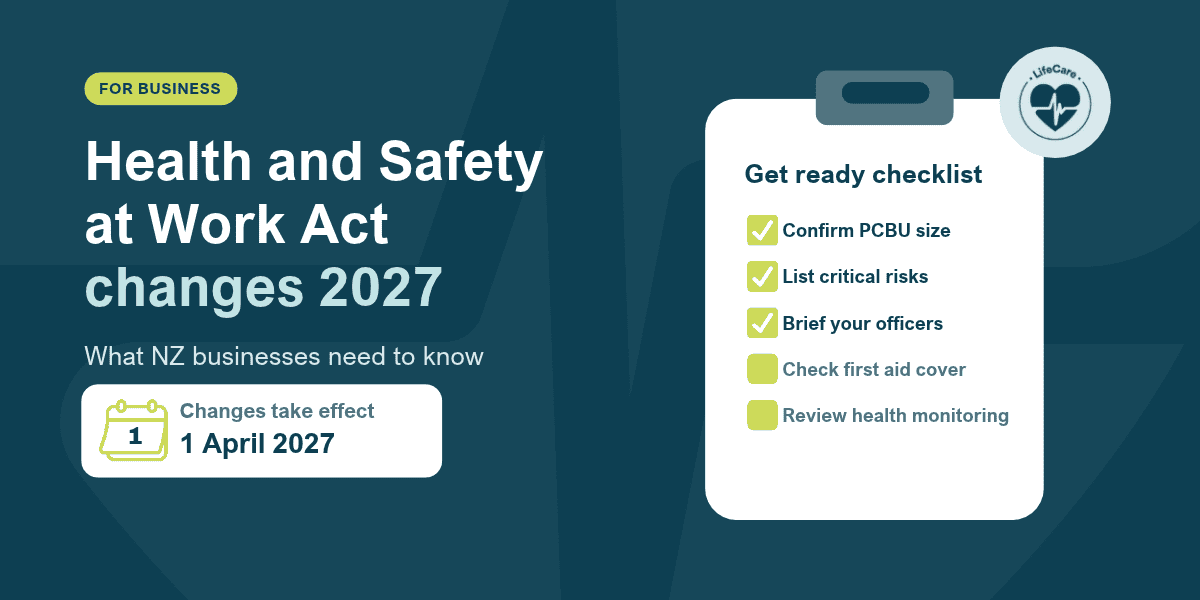
From 1 April 2027, the size of your business will help determine how you manage health and safety risks under New Zealand’s amended Health and Safety at Work Act 2015. The changes put greater emphasis on identifying and managing the risks most likely to cause serious harm, with different requirements for small and large businesses.
The sections below explain what is changing and how best to prepare:
The amendments place critical risks at the centre of New Zealand’s health and safety framework. Rather than treating every workplace risk in the same way, the updated legislation gives businesses clearer direction on which risks need the greatest attention. They change the Health and Safety at Work Act 2015, the WorkSafe New Zealand Act 2013 and the Health and Safety at Work (General Risk and Workplace Management) Regulations 2016.
The main changes include:
The changes come into effect on 1 April 2027, and until then businesses must continue to meet their obligations under the current Act.
A PCBU can be a sole trader, a company, a partnership, a school, a government department or a local council. From 1 April 2027, the number of workers carrying out work for a PCBU will determine whether it is classed as small or large.
| Small PCBU | Large PCBU | |
|---|---|---|
| Number of workers | Fewer than 20 | 20 or more |
| If numbers go up and down (seasonal or project work) | Expect fewer than 20 workers for at least 9 months of the financial year | Expect more than 20 workers for more than 3 months of the year |
| Risks you must manage | Critical risks | All risks, critical risks first |
| Working with other businesses | Cooperate on critical risks | Cooperate on all relevant risks |
| Worker welfare (toilets, water, first aid, emergency plans) | Yes | Yes |
Who counts as a worker? Employees, contractors, subcontractors, labour hire workers, apprentices, trainees, work experience students and regular volunteers. Occasional volunteers, such as people helping at a fundraiser, are not counted.
Two examples from WorkSafe:
A critical risk is a risk that is likely to lead to death, a notifiable injury or illness, a notifiable incident, or an occupational disease listed in Schedule 2 of the Accident Compensation Act 2001.
“Likely” is about how serious the harm would be if something goes wrong, not how often it happens. A forklift collision may be rare, but if one happens, serious injury is likely. That makes it a critical risk.
Some hazards are automatically critical because regulations cover them. They include:
Other risks may also be critical depending on the work and its potential consequences. WorkSafe’s examples include handling cattle, working around forklifts and moving loads, and roadside work.
Some harm doesn’t come from a single incident but develops over time. Noise can cause permanent hearing loss, and dusts and fumes may cause occupational respiratory disease. WorkSafe’s occupational disease guidance notes these diseases can take months or years to appear, and some are critical risks. Cumulative harm is not automatically critical. But fatigue becomes a critical risk where the likely harm is serious, for example a truck driver on long shifts who could crash.
From 1 April 2027, small PCBUs must manage their critical risks so far as is reasonably practicable. This is a simplification, not an exemption. They can still choose to manage other risks and can agree with other businesses (such as a larger client), to work together on them.
Examples of how this works in practice include:
WorkSafe recommends a practical, common-sense approach:
Large PCBUs will continue to manage all workplace risks, but critical risks are priority. WorkSafe’s guidance for large PCBUs describes this as managing critical risks first, reviewing their controls more often and directing more resources towards them. For example, a construction company would address falls from height before a slip hazard in its office; while a manufacturer would put dangerous machinery ahead of lower-level manual handling.
Large PCBUs must also cooperate, consult and coordinate with other PCBUs on shared risks, including with contractors and subcontractors. Agreements can clarify who does what, although no business can contract out of or transfer its own legal duties.
The officer duty applies to officers of every PCBU, large or small. Officers – directors, partners, board members and chief executives – must exercise due diligence to make sure the business meets its duties. For small PCBUs, this focuses on critical risks.
In practice, officers need to:
This could look like a board reviewing critical risk reports regularly and checking resources match the risks.
WorkSafe’s November 2026 guidance covers three more areas:
With workplace noise and substances hazardous to health among the critical risks covered by regulations, health monitoring and impairment testing can show whether your controls are doing their job.
Health monitoring can pick up early signs of work-related ill health. WorkSafe’s monitoring guidance makes clear that it doesn’t replace eliminating or minimising exposure but gives employers the information to focus where is needed the most.
LifeCare tests hearing to the Approved Code of Practice for the Management of Noise in the Workplace, using mobile clinics with sound booths for noisy or space-limited sites or at our clinics nationwide. LifeCare’s five-year benchmark of manufacturing workforce health found around 22% of employees assessed showed possible noise-induced hearing changes. LifeCare also provides spirometry, respirator fit testing to AS/NZS 1715 and fatigue assessments, with results available on LifeCare’s online reporting platforms within 48 hours.
Alcohol, drugs, fatigue and some health conditions can affect a person’s ability to work safely around machinery, vehicles or heights. Drug and alcohol testing, supported by clear workplace policies and procedures, can help manage these risks. LifeCare provides pre-employment, random, blanket, periodic and reasonable cause testing on-site or at a LifeCare clinic, with immediate results. A documented testing and health monitoring programme could help lower a business’s ACC levy over time.
LifeCare’s online reporting platforms can support this oversight by giving employers access to health monitoring reports, trends and benchmarks across their workforce. Reports are available within 48 hours and can be accessed 24/7, helping organisations review workforce health information across multiple sites.
Although the amendments narrow some duties for small PCBUs, worker welfare requirements continue to apply in every workplace, covering toilets, drinking water, hand washing facilities, first aid and emergency planning. WorkSafe’s first aid requirements include facilities, equipment and access to trained first aiders suited to the work, the workplace and the workers.
LifeCare’s guides to what a first aid kit should contain and how many first aiders a workplace needs can help you check your arrangements. Training options include the New Zealand First Aid Certificate for Business, delivered in one day at public venues nationwide or on-site, and Heart Start training for workplaces with a defibrillator.
Most businesses already have much of what they need, so the changes do not mean starting health and safety systems again from scratch. Before April 2027, consider these steps:
The amendments take effect on 1 April 2027, and the current Health and Safety at Work Act 2015 obligations apply until then.
A small PCBU has fewer than 20 workers or, where numbers fluctuate, reasonably expects to have fewer than 20 workers for at least nine months of the financial year. Any other PCBU is large.
Yes. First aid and other worker welfare duties apply to every PCBU regardless of size, with the right level of cover depending on the nature of the work, the workplace and the people on site.
If you follow an approved code of practice that has safe harbour, you are treated as meeting your duties for the risks it covers. It applies to codes approved from 1 April 2027 and two existing codes.
You don’t have to, although now is the right time to confirm your size, list your critical risks and check your first aid and health monitoring.
Knowing which risks matter most is the first step in preparing for the changes. It is also worth checking that your people have the first aid training, health monitoring and testing their work requires.
LifeCare provides workplace first aid training and occupational health services at locations throughout New Zealand, on-site and through mobile clinics. Whether you need to train a few first aiders, review health monitoring across several sites or arrange testing for safety-sensitive roles, talk to our team ahead of 1 April 2027.
Call 0800 493 559 or email info@lifecare.co.nz