10/02/2025
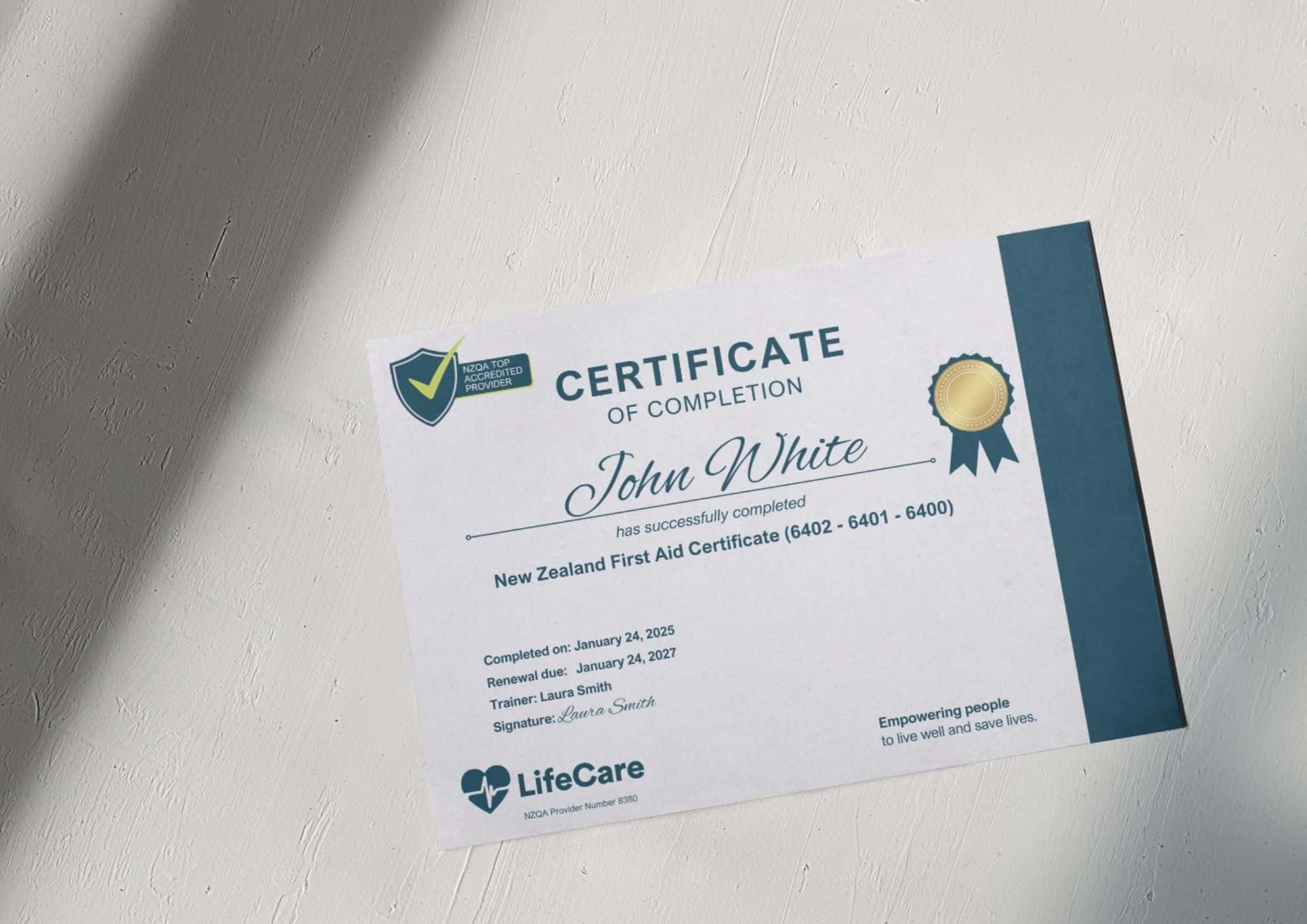
How Long Does a First Aid Certificate Last?
Wondering how long your First Aid Certificate is valid? Learn about renewal periods, industry requirements, and when to update your…


Every New Zealand business with staff pays an ACC levy, and a meaningful part of that cost is shaped by decisions made well before the invoice arrives. Here’s how the levy works, what changed on 1 April 2026, and where workplace drug testing and health monitoring could help bring it down over time.
In This Article
The ACC levy is a compulsory payment that funds New Zealand’s no-fault accident compensation scheme, covering treatment, rehabilitation and income support for people injured at work or elsewhere. Every employer with staff pays an ACC levy from the moment they take on their first employee, regardless of claims history.
It’s a statutory obligation set out by ACC, and the amount you pay is shaped by your industry, your payroll and, over time, your own safety record. Getting on top of ACC for business means understanding the levy types, the current ACC levy rates for your industry, and how your safety record feeds into Experience Rating.
The ACC levy breaks down into three separate levies, each funding something different, and only one of them responds directly to your organisation’s own safety record.
| Levy | What It Funds | Who Pays It | How It Is Set |
| Work Levy | Cover for injuries and accidents at work | Employers | Set by your Classification Unit (CU) and payroll, then adjusted by claims history through Experience Rating |
| Working Safer Levy | WorkSafe New Zealand’s injury prevention and regulatory work | Employers and self-employed people | A flat rate on liable earnings, currently 8 cents per $100 |
| Earners’ Levy | Cover for injuries that happen outside work | Employees, deducted through PAYE | A flat rate on earnings, currently $1.75 per $100 for the 2026/27 year, up to a cap of $156,641 |
The Working Safer Levy and Earners’ Levy sit largely outside an employer’s control. The Work Levy is different. It moves up or down based on your own claims history through Experience Rating, which means a consistently strong safety record can genuinely shift what you pay over time.
Three factors combine to set your Work Levy rate each year.
Important changes took effect from 1 April 2026. ACC removed the No Claims Discount for self-employed people and small businesses. The discount had rewarded an absence of claims rather than any proven improvement in workplace safety practice, and its cost was effectively being carried by businesses outside the programme, so ACC discontinued it in favour of a fairer model.
Businesses in Experience Rating now also pay an additional Experience Rating Programme (ER) rate, currently 7.2 percent, shown as a separate line on the Work Levy invoice. This applies regardless of claims history, which means a portion of your Work Levy is now fixed no matter how strong your safety record is, making the remaining, performance-based portion even more worth managing well. At the same time, ACC is moving the scheme to a fully self-funding model for the 2027 levy year, that means medium and large businesses participating in the scheme will directly cover the cost of their own discounts rather than being cross subsidised by businesses outside the programme. To offset rising costs, they have also raised the minimum medical cost threshold from $500 to $750. As a result, minor workplace injuries that cost under $750 are completely ignored, meaning fewer low-cost claims will negatively impact your safety rating or push you into a penalty zone.
Experience Rating weighs claims from the past three years, so a workplace incident today can still affect your Work Levy well into the future, even after the claim itself has been resolved. Reducing claims frequency now is one of the clearest ways to influence what you pay in years to come.
Example: A mid-sized manufacturing business demonstrates the principle well. If it steadily reduces the number and severity of work-related claims over three consecutive years, its Experience Rating position can move from a loading towards a discount band, lowering the Work Levy portion of its ACC invoice. The reverse also holds true; a rising claims trend can move a business towards a loading, whatever its industry risk profile looks like on paper.
Impairment, including from drugs and alcohol, is recognised by WorkSafe New Zealand as a genuine workplace risk under the Health and Safety at Work Act 2015. In sectors such as construction, forestry, manufacturing and transport, proportionate impairment management can help reduce the incidents that flow through to Experience Rating over time.
A documented workplace drug testing and health monitoring programme can offer your business two things that matter for Experience Rating; fewer preventable incidents, and clear evidence of proactive risk management if ACC or WorkSafe ever ask how you manage impairment and health risk.
At LifeCare, this typically includes pre-employment screening, random drug testing, health monitoring screenings such as blood pressure, lung function, blood glucose, fatigue assessments and functional capacity checks. These services can be delivered on-site, at one of our clinics, or via mobile clinics for remote or multi-site teams; and used together they help you catch risks before they become claims.
Prevention works best as an ongoing strategy rather than a one-off fix. A health monitoring programme can strengthen the evidence behind your safety record and support your Experience Rating position, alongside the more immediate benefit of a safer, healthier team. To find out how LifeCare can support your workplace testing and health monitoring programme, visit our workplace drug testing services page.”
The ACC levy funds New Zealand’s no-fault accident compensation scheme, which covers medical treatment, rehabilitation and income support for anyone injured, at work or elsewhere. Paying the levy is a legal obligation for every employer with staff, and it replaces separate workplace injury insurance or the right to sue for personal injury.
Self-employed people typically pay a Work Levy based on their Classification Unit and declared income, plus the Working Safer Levy and Earners’ Levy. Rates vary by industry and income, so the most accurate way to check your figure is through ACC’s levy calculators rather than a general estimate.
The Work Levy and Working Safer Levy are generally tax deductible, since they relate directly to running your business. The Earners’ Levy is deducted from wages through PAYE and treated differently. Check your specific situation with your accountant or business.govt.nz.
The Earners’ Levy covers the cost of injuries that happen outside work, such as at home or during recreation. It is deducted directly from employee pay through PAYE at a flat rate, currently $1.75 per $100 of earnings for the 2026/27 year, up to an annual cap.
From 1 April 2026, ACC removed the No Claims Discount for self-employed people and small businesses, as it was not delivering the expected health and safety improvements. Businesses in the Experience Rating programme now also pay an additional Experience Rating Programme (ER) rate, currently 7.2 percent, shown as a separate line on their Work Levy invoice. This rate applies regardless of claims history and helps make the Experience Rating programme self-funding rather than relying on other businesses to cover the cost.
The portion of your ACC levy tied to your safety record is the one you can genuinely influence. Understanding your Classification Unit, watching your claims history and building a proactive workplace drug testing and health monitoring programme all support a stronger position as Experience Rating carries more weight each year.
LifeCare’s clinical team, including occupational health nurses, registered nurses and occupational health technicians, have supported New Zealand employers for more than 30 years, with offices across the country from Auckland to Invercargill and mobile clinics reaching remote and multi-site teams. If you would like help reviewing your current approach to risk mitigation in the occupation health space, talk to our team about drug testing and a health monitoring programme suited to your industry and risk profile or learn more about who we are.